
#30 - The Dangerous Playground Effect
Why dangerous playgrounds have their place in a thriving society

I’m gonna be honest… I have no idea how I survived this as a kid:
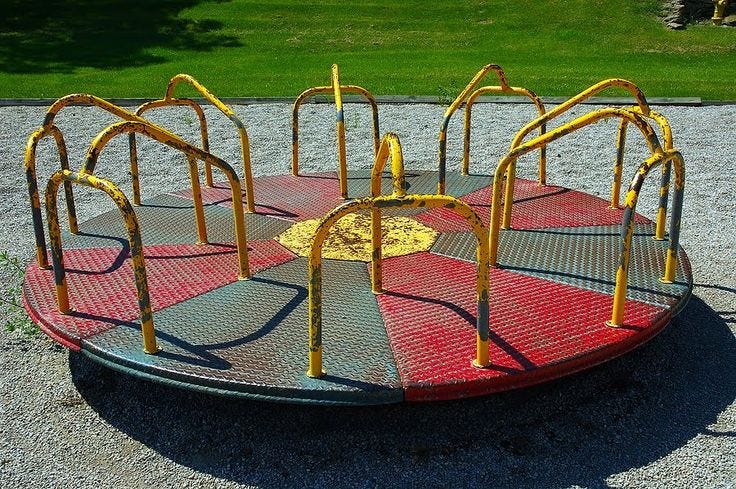
A whirling metal plate? Naturally, we’d get this thing spun up as fast as we could go, jump on, and hang on for dear life. Sometimes while pushing it you’d fall and maybe almost get your leg stuck under it, but normally not.
Surprisingly, this was not one of the four ways in which I broke my front teeth, but it very well could have been, and I’m sure there were many such cases of kids getting their teeth knocked out by this thing.
And all that… is a good thing?
Modern society has trended towards safety across many different dimensions over the past 80 years. Playgrounds offer clear illustration of this cultural shift.
We went from:
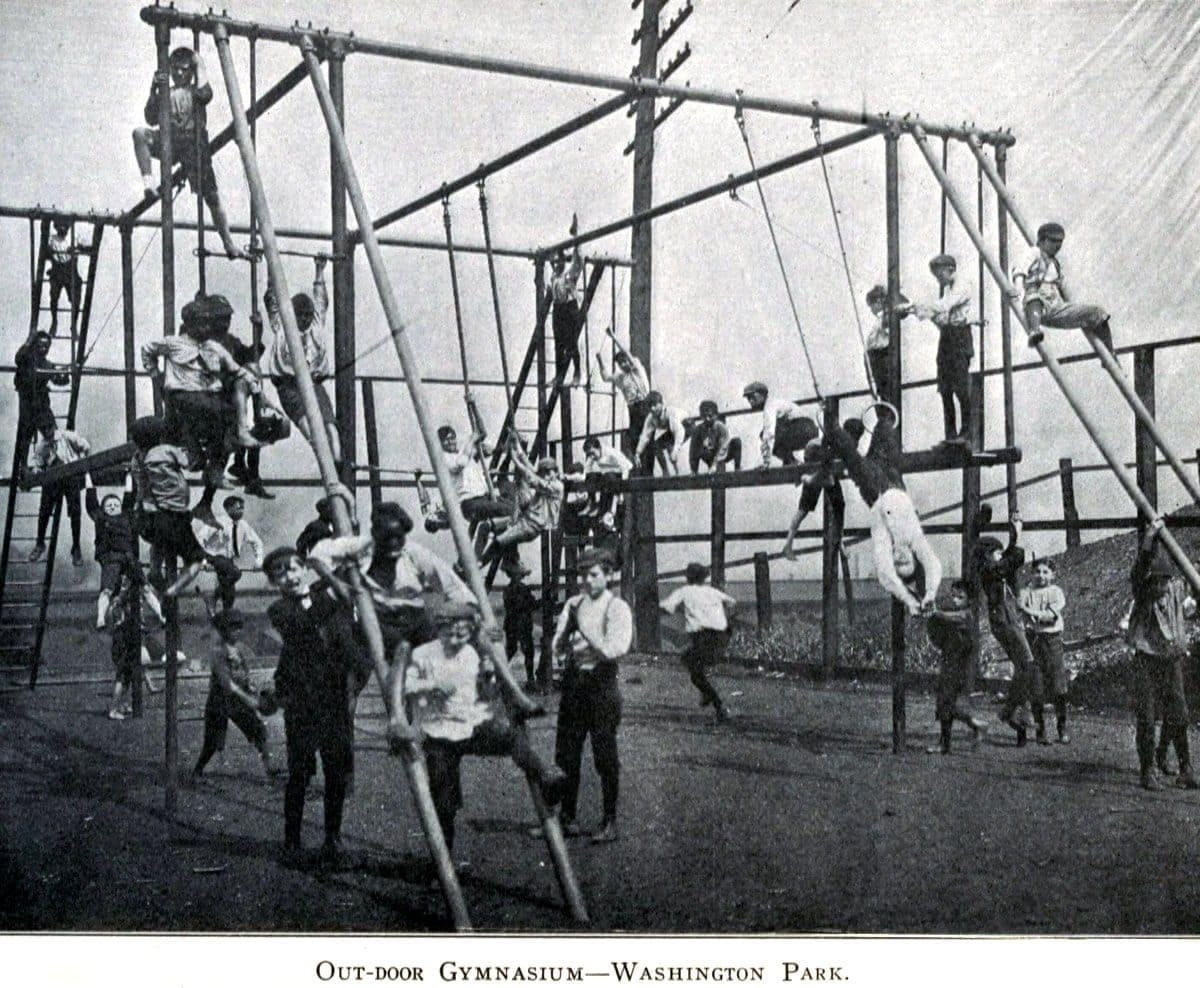
To this:

And of course the question we are all asking ourselves is this: is this shift a good thing?
If we use our handy orders-of-thinking scale (relevant reading below), we can surmise:
First order: Danger is FUN! I hope my kid gets his teeth knocked out, just like me and my ‘paw.
Second order: Any child injured, any life lost is bad, we must work to prevent such atrocities however possible.
Third order: Child safety is a relevant concern, but the inadvertent consequences of optimizing for safety may be worse than dangers that playgrounds present.
For context on orders of thought, check out:

We’ll examine that third case as it’s the only interesting point. Of course, in a vacuum we don’t want kids getting injured on a playground. But that isn’t the actual choice that we face!
Rather we face a decision, on balance of:
A kid can learn about risk and danger in a semi-controlled environment of a playground where they may get a cut or a bruise, break a bone, or (in rare cases) sustain even more serious injury. Or,
A kid can live in a padded environment, never needing to fear a broken bone, but also never learning how to handle risk and danger in a responsible way.
While not a parent yet, I do have seven nieces and nephews. We’ve taken them to the playground, and I’ll admit I’ve watched them closely, trying to prevent any danger from befalling them.
It’s human nature, of course. Ask any parent about this choice for their own child and their gut says to go with the safe option.
But to a dispassionate observer (or a sufficiently low empathy parent or relative), this answer is clearly wrong.
Even the New York Times (to its rare credit) has arrived at this conclusion in a 2019 piece. Kids need to learn about independence, risk, and danger - none of which can be taught be a parent nearly as well as they can be experienced! Playgrounds are actually perfect for this: it’s still a semi-controlled space, but kids can test their own limits and learn about risk first-hand in that environment.
The danger our playgrounds used to present may well be a case of Chesterton’s Fence: the danger was there for a reason, but we’ve removed it without asking why it was there in the first place.
#9 - Chesterton's Fence

One great concept I’ve been using recently is that of Chesterton’s Fence. Proposed by G.K. Chesterton in 1929, it’s a great one to keep in mind whenever thinking about politics, entrepreneurship, or any complex system. The basic thought experiment goes like this: you come across a fence in a field that has no discernable purpose. Your first reaction migh…
The fact is that humans need to learn how to handle risk and danger. No matter how much we wish it away, risk and danger will come. Humans want to minimize this, and we should… to a point.
Playgrounds appear to have served a vital purpose in exposing kids to clear risks and dangers in a semi-controlled environment. By removing that, we’ve created a generation or two that don’t do too well when faced with true threats.
Presented with a safe and a dangerous playground, most (perhaps all?) parents will instinctively choose the safe one, it’s only natural. But the world will not acquiesce to our desires for safety. While we may seem determined to learn this lesson the hard way, farsighted parents should look for ways to give their kids first-hand experience handling risks and danger.
A playground where a kid may lose a tooth or two would be a good start.